Hangzhou, the southern terminus of the Grand
Canal, is a beautiful “town” of 8.7 million people. It is hard to have a quaint
town of 8.7 million, but there were many parks and water features in the town
that gave it a livable feel. By comparison our guide called Suzhou “tiny”
because the buildings were required to be no more than three stories tall in
the historic areas and it only has 4 million inhabitants.
 |
It took at least 5 minutes to cross this 25 meter bridge because
of the crowd. Everyone had to stop to take a photo. |
The Grand Canal, 1,764 km (about 1200 miles) long, is the world’s longest
man-made waterway, far surpassing the next two: the Suez and Panama Canals. By
comparison the Erie Canal is only 363 miles. Running from Hangzhou in the south
to Beijing in the north, it connects several river systems.
 |
| Even the trash is picked up by boat. |
The canal was built section by section in different areas
and dynasties before it was linked together by the Sui Dynasty (581-618). The
project took over six years. Approximately half the peasant builders (about 3
million) died of hard labor and hunger before it was finished. This project
wasted men and money and resulted in the downfall of the Sui Dynasty.
 |
| Watching the traffic on the canal |
 |
| Did I mention that it was crowded? |
The Grand Canal, which joined the river systems from different
directions, allowed goods to be transported from south to north. It also
greatly improved the unification and defense of China, strengthening economic
and cultural ties between north and south. Like the Great Wall, the Grand Canal is one of the most
magnificent constructions in ancient China.

 |
| An "alley" off the Grand Canal |
 |
| Steps from your back door to the canal |
 |
| Only in Venice have we seen so many nice bridges. |
Suzhou is located in the center of the
Yangtze Delta, with Shanghai and the East China Sea to the east and the
Yangtze River to the north. Since 42% area of the city is covered by water,
including a vast number of ponds and streams, it is called the 'Oriental
Venice'. (Just because it has canals, doesn't make it Venice!) The city is cut by the Beijing-Hangzhou Grand Canal from north to south. With its mild climate, history
and natural beauty, it is no wonder that Suzhou is called 'paradise on earth'.
The city is noted for its beautiful gardens. Among them are Lingering Gardens
and Humble Administrator’s Garden (not an oxymoron in Chinese culture).
 |
| Hobbit lawn furniture |
 |
| In the circle of life. |
  |
| Bonsai tree in a Bonsai garden being tended by a Bonsai gardener |
  |
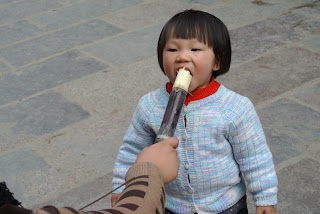
| Above - Mom (next to Suzanne) wanted a picture with her children and a blonde. Again Suzanne is the most popular girl in town. Below is a dentist's nightmare. |
 |
| This is the proudest Grandpa in China with twin girls! |
 |
| 3 American Scouters up to no-good |

|
| 7 Chinese non-scouters up to something |
 |
| I would be willing to have orange hair. |
Built in 514 BC, Suzhou is an ancient city with a 2,500 years'
history. It has the feel of a Chinese Williamsburg or Nauvoo. The city is
original or reconstructed in the ancient style. The double-chessboard layout of
the city, with the streets and rivers going side by side while the water and
land routes run in parallel, are preserved basically intact.
 |
| No better way to enjoy a day with dad. |
Strolling the
streets and canals, you are transported back into China of 1000 years ago. If
it were not for at least 50% of China’s 1.3 billion population visiting for a
holiday and crowding the sidewalks made for two people, it would be a perfect
getaway. We would highly recommend this city if you tour China. However, stay
away on any Chinese holiday, because this is where they go. It is truly a
beautiful ancient city with a lot of charm and character.
 |
| Tai Chi in the park |
 |
You can't throw a stick in this town without hitting a bridge.
|

Suzhou is also known as the wedding dress capital of China, as most
of the world’s wedding dresses are made here. There are shop after shop after
shop as far as the eye can see of wedding dresses. The customary Chinese
wedding dress in past times has been red; however, white ones are also very
popular. Often a bride will have one of each, and she will travel to Suzhou to
find the perfect one(s). She will have a red one for the ceremony and family
party and a white one for photos in the park.


Of course, the legal
marriage is completed when the bride and groom fill out a form at the official
government agency-no dress needed for that. Many of the teachers we work with
have made this pilgrimage for their dresses for Western style celebrations. Our
students are the first generation that has been able to choose their own mates.
Grandparents and even many parents of the kids have had their marriages
arranged. Some have seen their spouse for the first time on their wedding day. Because
of this “true love” status of today, many will go all out.
 |
| Nice Bow tie - it matches his pants |


 |
| Now just where did I leave my red heels? |
It is common today that the groom’s parents
provide housing and a car for the new couple. If the couple marries without any
resources (like many in the US), this is called a “naked marriage”. This term
conjures up something entirely different in our minds!


There is an interesting wedding custom in China. The groom arrives
at the bride’s house to take her to the ceremony; he and the best man must
perform some duties to appease the mother-in-law. While the groom continues the
traditional suck-up rituals, the best man searches the house for a pair of red
high heels belonging to the bride that she will wear to the wedding. If the
mother-in-law does not approve of the match, the heels will be very well hidden
and it will take a looong time for the best man to find them. This is her final
opportunity for protesting the wedding. If it is an easy search or the best man
finally finds them, the groom places the heels on the bride and they walk to
the waiting car. If the heels are not found, the groom must carry the bride. It
signifies to all that Mom does not approve of the match. Of course, as soon as
a child is born, all that changes. Even with that, though, the divorce rate is
climbing here in China. One of the Chinese teachers told us that it now equals
that of the U.S.
Churches in Xi’an
Even though the People’s Republic of China is a communist country,
there are organized religions here and people are allowed to practice their
religion without interference from the state. If you decide to become a member of the Party,
however, you are required to renounce any religious beliefs. The main religions
in China are Taoism (24%), Buddhist (15%), Christian (4%) and Muslim (1%).
There is a large margin of error in these estimates with about 60% of the
population being agnostic or atheist.

With so few believers in China, you don’t find a church,
cathedral, mosque or temple on every street corner. But when you do find one,
it is a gem! We really enjoy the Muslim section of Xi’an. As expected in the
heart of this area is the Grand Mosque.
It is surrounded by a high wall, has 5 sequential courtyards with walls and
grand entryways separating each courtyard. There are gardens, water fountains,
stone formations and exquisite carvings on the lentils, door jams and walls.
There is a sense of community in the mosque where the faithful come to pray
five times a day. We enjoy being there on Friday afternoon when the majority of
the faithful come to pray. They are very sincere in their worship with a charge
to help the poor and needy. This mosque has an interesting combination of
Middle East feel with a Chinese interpretation.
The Catholic Church is
a far cry from Notre Dame de Paris, but it is a peaceful haven in the middle of
a pagan country. The church can hold several hundred worshipers for Mass. We
were there on a Friday so there were only a few parishioners there for prayer.
Interestingly, a few Chinese folks came in and were greeted by one of the faithful.
We observed them open the scriptures for a discussion. The Chinese are allowed to discuss religion
and theology with each other, but foreigners are forbidden to discuss religion
with a Chinese national.


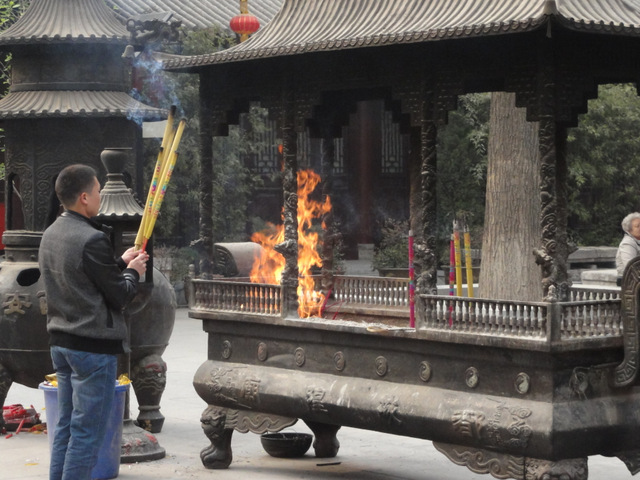
Duchenghuang Temple (Taoist) is a short walk from the Muslim area
and the Catholic Church. There is the heavy smell of incense and the sound of
gongs and chanting. To keep from giving false information regarding the beliefs
of this group, I’ll just share my observations of the temple area. There were
numerous golden colored statues of supernatural beings, monks, incense burners
and worshipers. It’s a very reverent place with quiet and peace in the center
of a busy city. This temple is quite old.

Well I guess it's time for church, gotta go.